Offset smokers are often talked about as the bee’s knees of bbq. They’re used in competitions and restaurants and undeniably make some darn good meat which is of course, what we’re here for. But, using an offset smoker is very hands on and time-consuming…
Enter the pellet smoker. It’s a 100% wood fire but is literally set and forget. So, is pellet the way to go these days? How good is meat cooked on a pellet smoker?
If you’re tossing and turning about which barbecue to buy, this offset smoker vs pellet smoker comparison will give you all the information you need to make the best decision.
Here you’ll find info on how these similarly looking barbecues work, the pros and cons of both, how they’re the same, what makes them different, as well as a cost comparison, and popular opinions on both.
Then, once you’ve decided which way to go, we’ll point you in the right direction for reviews on the best offset smokers and the best pellet smokers on the market.
Burning Brisket is reader-supported. When you buy through links on our site, we may earn an affiliate commission. Read our affiliate policy to learn more.
A Quick Comparison of the Offset Smoker vs Pellet Smoker
Table of Contents
What Is an Offset Smoker?
An offset smoker is a type of barbecue that consists of two connected and offset chambers; the firebox and the cooking chamber.
Inside the firebox burns a charcoal and/or hardwood log fire. From there, the heat and smoke travels up and through to the cooking chamber to provide indirect heat to cook and smoke the food inside the cooking chamber.

This design allows for a separation of the heat source from the cooking area, which is perfect for low and slow cooking because the direct and high heat from the fire is set away from the food.
Offset smokers are renowned as the gold standard when it comes to smoking. And, because of this, they’re a popular type of barbecue for enthusiasts who want the most traditional smoking experience that allows for the greatest control over the cooking process.
Using an offset smoker requires the hands-on, manual maintenance of the heat. Adjustments to the barbecue’s dampers to increase or decrease the air intake to create a steady temperature inside is a time-intensive process and does require a certain level of skill.
With the reward of rich and smoky results that are competition and restaurant quality, some users think that offset smokers produce the best quality meats and that the extra time and skill needed to produce them is completely worth it.
How Does an Offset Smoker Work?
In an offset smoker, air drafts through an offset smoker’s firebox, pushing through the cooking chamber where it provides heat and flavor to the meat, and out of the smoke stack or chimney.
The temperature is manually controlled by adjusting and maintaining the amount of fuel that’s in the firebox as well as adjusting the vents to control the flow of oxygen which in turn, increases or decreases the heat that the fire puts out.
The more open the vents, the more oxygen is allowed into the smoker and the hotter the fire will burn. The more closed the vents are, the less oxygen is allowed into the barbecue, allowing the fire to burn at a lower and slower temperature that’s perfect for smoking.
The video below gives a thorough run-down of how to use an offset smoker.
Advantages and Disadvantages of Offset Smokers
Pros
- Great flavor & quality results
- High level of control over the smoking process
- Allows you to cook with wood logs
- Suitable for cooking a lot of meat at once
- Generally a very durable bbq
- Some can be used as a grill as well
Cons
- Frequent refuelling
- Regular fire maintenance is necessary
- Steep learning curve
- Paint peels on many models
What Is a Pellet Smoker?
A pellet smoker, also known as a pellet grill, is a type of barbecue that burns pellets made from 100% compressed hardwood as its fuel source.
It’s pretty much a combination of an electric smoker and an offset, offering the convenience of set and forget, automatic temperature regulation with the flavor of real wood.

In recent years pellet smokers have slowly worked their way to becoming the most popular type of barbecue because, one, they’re so easy to use, and two, they make really great food. The meat is so good in fact, that pellet smokers are even a popular weapon of choice on the competitive barbecue circuit, although, understandably, some people think they should be banned.
Because pellet smokers are electric, they do require power to run the control panel that powers the auger to feed the fire. So, you’ve got two costs to factor in when you’re looking at their running costs.
But, at the end of the day, if you want free time to do other things while you’re barbecuing, pellet smokers easily give you the next best thing in terms of quality results, and they’re pretty effortless to use. Anyone can make incredible food on one.
How Does a Pellet Smoker Work?
To start a pellet smoker it’s as easy as turning it on and following the start up procedure.
Regardless of which model you choose, a pellet smoker does not need to be manually lit. Most pellet smokers need to be set to ‘smoke’ or a similar startup mode while the smoker ignites the pellets and starts them burning. Then, you select a target temperature on the control panel and wait while the barbecue heats itself up.

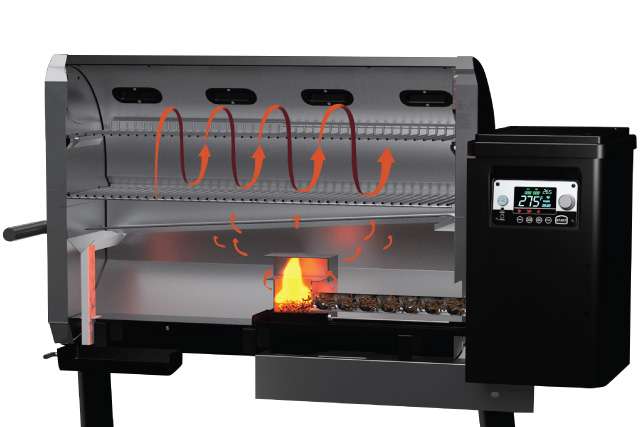
What’s happening inside is that there’s an auger that turns, transporting hardwood pellets from the pellet storage hopper to a small firepot that’s located underneath a heat absorbing baffle plate that sits below the cooking grates.

An air intake fan provides oxygen to the fire to help the pellets burn, allowing more air for higher temperatures and less air for lower ones. In addition to this, when a higher target temperature is set, the pellet smoker will feed pellets into the firepot at a faster rate, providing more fuel as is required. And, for a low and slow temperature, it’ll provide less pellets that can burn at a slower rate.
The pellet fire provides both heat and smoke for cooking.
What’s usually a solid baffle plate blocks the direct heat from the pellet fire, acting as a heat sink to radiate indirect heat from the bottom of the cooking chamber up. The smoke naturally circulates inside the cooking chamber before leaving through a chimney or other vents just like it does on an offset smoker.
With the temperature control taken care of, you then simply place your meat on the cooking grates above and only need to go back to the barbecue if you want to wrap, spritz, sauce, or get your meat out because it’s time to eat.
Advantages and Disadvantages of Pellet Smokers
Pros
- So easy to use
- Very steady temperature for consistent results
- Automatically produce good quality smoke
- Real wood flavor
- Some have WiFi for remote control
- Can be very fuel efficient
- Versatile bbq that can roast, bake & often grill
Cons
- Requires electricity
- More mild flavor than an offset
- Technical components can break over time
- Often no open flame grilling
How Similar Are Offset Smokers and Pellet Smokers?
Both offset smokers and pellet smokers use:
- 100% hardwood as the source of heat and smoke
- Indirect heat
- What's usually a large, horizontal cooking chamber
- High heat for grilling as well, depending on the model
But, because one requires manual management of the heat and smoke source and the other is automatically controlled, offset smokers and pellet smokers aren’t considered to be very similar at all.
How Are Offset Smokers and Pellet Smokers Different?
Ignition
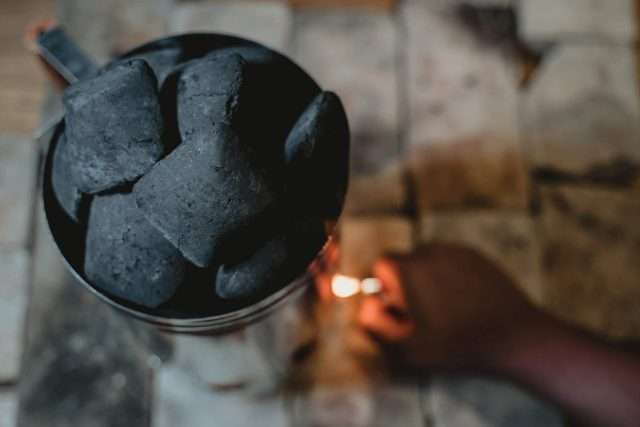
Offset smokers require you to manually light the charcoal or wood before burning it in the firebox while pellet smokers are automatically ignited by a hot rod.
If you’re using charcoal, briquettes or lump pieces are most often lit in a charcoal chimney before being tipped into the firebox. A wood fire is usually built and started directly in the firebox with kindling to help to get it going.
Temperature Control
To maintain a steady temperature on an offset smoker does require a fair amount of skill and practice.
The right amount of fuel must be placed in the firebox and added to as it burns through. But, the air intake vents need to be adjusted throughout the cook as well in order to maintain a steadily burning fire to keep the cooking temperature as even as possible.
An even temperature makes it easier to cook consistently great meat. Spikes can burn and dry out slow cooked meats while dips can extend out the cooking process considerably. So, slow and steady is the goal but it does require you to check the offsets temperature and make any necessary adjustments every hour or so.
How much fuel and at what position the vents should be set will be influenced by the weather conditions including air temperature, wind, rain, and snow. What worked for one cook might not be what’s needed on a different day. There’s no substitute for getting hands-on experience on an offset smoker to learn and master how to maintain that temperature.

Once you’ve set the target temperature on a pellet smoker, the smoker will regulate it for you, adjusting the air intake and feed rate as is needed.
That doesn’t mean if you set your smoker to 225°F it’ll stay there perfectly. Fluctuations will happen throughout your cook, even if you keep the lid closed the whole time.
There’s two different types of temperature controllers used in pellet smokers. Regular or older style controllers generally keep the temperature within about 25°F plus or minus of your target. Newer, PID or Proportional Integral Derivative controllers have a more complex algorithm behind them that can stick impressively close to your set target, varying just 5°F plus or minus of your target.
Flavor, Smokiness and Healthiness
Most smoking traditionalists argue that, when cooking with hardwood, offset smokers create a stronger smoked flavor with deeper smoke rings and better bark than you can achieve on a pellet smoker.
Pellet smokers have a reputation for producing a slightly more mild flavor.
In our experience, whether you go offset or pellet, the type of wood used for smoking is what plays a significant role in how smoky the meat turns out.
While you can create a stronger, smokier flavor on an offset smokers, it’s usually because of poorer fire management. Thicker smoke, which isn’t as good for your health, can produce a stronger flavor but if that smoke is also dousing your food in less than ideal components, that ‘flavor’ isn’t necessarily a good thing.
On the other hand, most pellet smokers are set up to burn at the right temperature with good airflow to produce thin blue smoke. Drippings on a dirty heat deflector can be a source of less ideal smoke. But, a clean pellet smoker usually produces good quality smoke which provides a noticeably smoky flavor, good smoke rings, and nice bark.
Versatility
Offset smokers are made to be used at a low and slow temperature. With manual temperature control though, you can run them hotter if you with.
Some models of offset smokers also come with a cooking grate for the firebox that lets you grill and sear directly over the wood or charcoal fire. Additionally, some offset smokers also come with charcoal grates for the main cooking chamber so that you can convert the larger space into a charcoal grill.
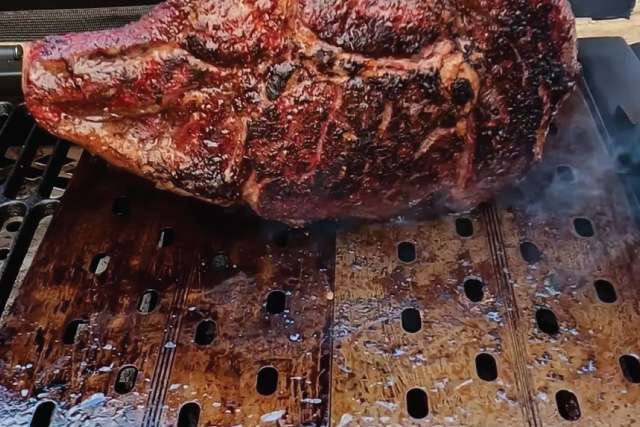
The temperature controller on most pellet smokers has quite a wide temperature range that’s suitable for low and slow smoking, baking, roasting, and even grilling.
While some pellet smokers have a way to cook directly over the pellet flame, most don’t and you’re grilling over indirect high heat which can be quite different to the open flame experience you get on an offset smoker.
That being said, a steak grilled over indirect, high heat on a pellet smoker can turn out pretty decently.

Jump to our review of the best pellet smokers for grilling for specific models that are well set up for high heat cooking with direct searing options as well.
Dependence on Electricity
Although pellet smokers do use hardwood as the source of heat and smoke, the electronic control panel, motor that runs the auger, and the associated air intake fan do require electricity to operate.
Pellet smokers cannot be used without power and are quite useless in a power outage.
To be used off-grid or on the go, there are a number of ways you can power a pellet smoker. For more information on that, check out our guide on how to power a portable pellet grill.
Offset smokers do not require any electricity. As such, they can be used anywhere without needing power outlets or extension cables.
Running Costs
How much it costs to run an offset smoker vs pellet smoker will depend a lot on which type of fuel you’re using.
The best case is that you’ve got access to your own hardwood firewood that you can cut down and split to run your offset smoker for free.
But, if you’re buying logs or charcoal to burn in it, running an offset smoker can cost quite a bit.
Pellet smokers will always require you to buy two things to run them, the hardwood pellets themselves, and the electricity needed to run the thing.
Pellets aren’t particularly cheap to buy. But, at low and slow temperatures, they are quite an efficient fuel source that on average, burns about 1 pound of pellets per hour of smoking time.
High heat grilling does chomp through the pellets, costing a lot more per hour of cook time. You would run the smoker for a shorter time if you’re just bumping it up to grill a steak though.
Involvement required
With an offset smoker relying on you to establish and maintain a suitable temperature for smoking, an offset smoker is the most hands-on type of smoker you can get.
You will be largely tied to the thing on barbecueing days. The wife, husband, and/or kids might not be too happy about it, and the yard work probably isn’t getting done. But, having a beer and hanging outside while you tend to the fire can be quite enjoyable if you’ve got the time.
Pellet smokers on the other hand, free your weekends up almost completely.
Pop the smoker on and mow the lawn, get stuck into your latest build project, hang out with the kids, or do anything other than having to carefully watch the temperature and adjust dampers.
Learning Curve
Pellet smokers are so easy to use. They’re perfect for beginners with absolutely no previous barbecuing experience and you can turn out really good results from the very first cook.
Offset smokers aren’t as easy to use.
Yes, you can be a fresh beginner and use one. But, you’re going to need to invest some time into mastering the variables and learning how to control the heat and smoke for really great results. Still, there’s no other way to learn but jumping on in there. If you’re keen, don’t let anyone tell you offsets are just for more experienced cooks. You get that experience by using one.
Quality of Results
You can cook really great, competition-worthy barbecue on both an offset smoker and a pellet smoker.
Both are capable of creating great smoke rings and bark, flavorful and moist meat. Either really do produce the best smoked meats you can make.
But, if you’re a beginner, you’re going to be making great food on a pellet smoker much sooner than you will on an offset.
Cost Comparison
When shopping for an offset smoker or a pellet smoker, there’s a big price range from very cheap models offering an affordable entry point to high-end brands with unique features aimed at making the smoker more durable and the experience, easier.
Overall though, you can spend less to get a pellet smoker that works well and is alright quality. Although there’s a lot of cheap offset smokers on the market, most don’t work very well. Better quality offset smokers are quite expensive to buy.
Here are two offset smokers and three pellet smokers of a similar quality so that you can compare the different price points.
Check out our best offset smokers review for more options including more expensive, better quality offsets.
And, read our best pellet smokers review for more options there.
Pitmaster Opinions & Preferences
Pitmasters are all about mastering the variables of smoking and no single variable is more important than the fire. Using an offset smoker gives you control over that element so that you can truly master the art of bbq.
But, that doesn’t mean that all pitmasters use or stand by offset smokers as the only good option.
Produces his own Franklin BBQ Pit that’s based on his own experience cooking with real fire for years in his restaurant.
“[Pellet smokers are] all about control. And convenience. Oh yeah, taste, too. Set it and forget it. Great flavor. No brainer. Pellet burners are a real revolution.” from his discussion on pellet smokers.
Myron Mixon sells his own range of pellet smokers that are large capacity, high-quality models suitable for commercial use.
Snows BBQ in Texas uses offset smokers to cook all of the meat sold in their restaurant that’s rated as one of the best in Texas.
Oklahoma Joe’s have traditionally sold offset smokers. But, in what’s aimed to be an impartial test of how good a brisket that’s cooked on an offset smoker vs pellet smoker really is, Steve found that both brisket’s were actually very much comparable.
But, what pitmasters think isn’t always the best thing to follow for using at home.
There’s a lot to be said for the ease of pellet smoking.
My general advice, after years of testing and recommending the best smokers to people is that if you don’t have or want to spend the time on learning how to and actually smoking food on an offset smoker, go for a pellet.
As for if it’s cheating or not… What’s wrong with being able to cook really great brisket and do it easily?
It’s alright if your life isn’t all about barbecue. You can still enjoy a really great barbecue at the end of the week without having to dedicate the day to it.
So, What’s Better? Offset or Pellet Smokers?
As with anything in barbecue, there’s never a one-size-fits all solution. And, when it comes to the offset smoker vs pellet smoker debate, that rings very true.
At the end of the day, they’re both great types of smokers that use real wood to smoke really delicious meats.
An offset smoker is probably the best choice for you if you:
- Like doing things the ‘proper’ way
- Have the time to dedicate to smoking every time you feel like eating some barbecue
- Are prepared to put the time and effort into learning how to use an offset pit
A pellet smoker is the better choice for you if you:
- Want to make really great barbecue while putting the least amount of effort in
- Have access to power in your backyard
- Want more high-tech features like WiFi for remote control
Buying a Good Offset or Pellet Smoker
Regardless of whether you’ve decided on an offset or pellet smoker, getting a good one will make a big difference in how good your barbecue is going to be.
Here’s a sample of our favorites, or click one of the links below to see our full reviews.
Our Favorite Offset Smokers

Oklahoma Joe's Highland
- Works well but basic
- Good value for money
- Will leak some smoke

Yoder Loaded Wichita
- Excellent, made in USA quality
- Even temperature
- More expensive than a lot

Dyna-Glo Wide Body
- Very cheap
- Large cooking capacity
- Harder to set temp
Read our full review of the best offset smokers, the best offset smokers under $1000, or the best offsets under $500.
Our Favorite Pellet Smokers


recteq Flagship
- Stainless construction
- Larger than average
- None

Z Grills Multitasker
- Fully insulated
- WiFi
- Quality not as good as Traeger
Read our full review of the best pellet smokers.
FAQs About Offset Smokers vs Pellet Smokers
Both offset smokers and pellet smokers have their pluses and minuses.
Offset smokers are better than pellet smokers if you enjoy actively barbecuing and want total control over the process. They do produce a slightly smokier flavor.
Meat smoked on a pellet smoker will taste almost the same as it will on an offset. But, they’re a set and forget that you don’t have to manually manage the temperature on. So, for great meat without much effort at all, pellet smokers are the better choice.
Offset smokers are often used by professional pitmasters because they offer total control over the smoking process with manual fire management that’s really barbecuing.
But, there’s not only one side to any story and pellet smokers can be a better choice if you don’t want to spend hours checking on and adjusting your fire.
A pellet smoker still lets you use real hardwood to cook with but the temperature and smoke is automatically regulated by the digital control panel making them a set and forget solution.
In a side by side comparison of a brisket cooked on an offset vs pellet smoker conducted by Steve Gow from Oklahoma Joe’s smokers, he found that there was almost no taste difference between the two. And, we would have to agree.
Meat smoked on a pellet smoker can taste just as good as meat smoked on an offset smoker. After all, both are using 100% hardwood as a source of fuel.
However, it’s a lot easier to cook great food on a pellet smoker. An inexperienced cook or someone still learning their pit can easily make worse food on an offset. You need to know how to manage the fire to get great results.
A beginner on an offset smoker more than likely won’t make as good a meat on an offset as they could on a pellet smoker with little or no experience.
But, as an experienced barbecue professional, pellet smokers can be a healthier option purely just because it’s easy to create good, thin smoke that is healthier to cook with.
If you don’t know how to manage a fire well on an offset, it’s easy to create less than ideal smoke for cooking that can create a bitter flavor and put unwanted deposits onto your food.
Yes, a quality pellet smoker does produce enough smoke to impart great flavor in any meat cooked on one.
It often looks like a pellet smoker isn’t putting out much smoke. But, that’s usually because it’s clean and clear thin smoke that is harder to see. The flavor is still there though and you’ll see it in great smoke rings on anything that’s cooked on a pellet smoker.
Pellet smokers are the easiest way to create bark that compares to the legitimate results you can get from a traditional offset smoker.
It’s full of flavor and has a nice crispy texture while the heat deflector blocks the meat from charring or burning.

Kate Brown is the founder of Burning Brisket, where she shares hands-on smoker reviews, barbecue gear guides, and practical tips for backyard BBQ. She has cooked extensively on charcoal, pellet, electric, and kamado smokers, using real-world experience to help beginners choose the right equipment and make better barbecue at home. Her focus is honest, straightforward advice that makes smoking and grilling easier without unnecessary complexity.